
GNSI conferences are one of the great opportunities for science illustrators to experience different environments.
Each year, the meeting is hosted in a different location, allowing exploration of unfamiliar ecologies and local cultures. It’s fun to visit new places with friends and colleagues of similar bent, and it exposes the hosting communities to the world of scientific illustration.
Meetings are almost always hosted on college campuses. Host campuses bring together easy, relaxed gatherings combined with access to the buzz of a learning experience, and allows for city selection in a wider variety of locations and economical pricing.
With each location comes a new combination of exploration/field trip opportunities. Whether it is turtle hunting with research scientists, studying cave ecology, going behind the scenes in a new museum, or examining the art in rare natural history tomes, there is something new for everyone to experience with each new conference.
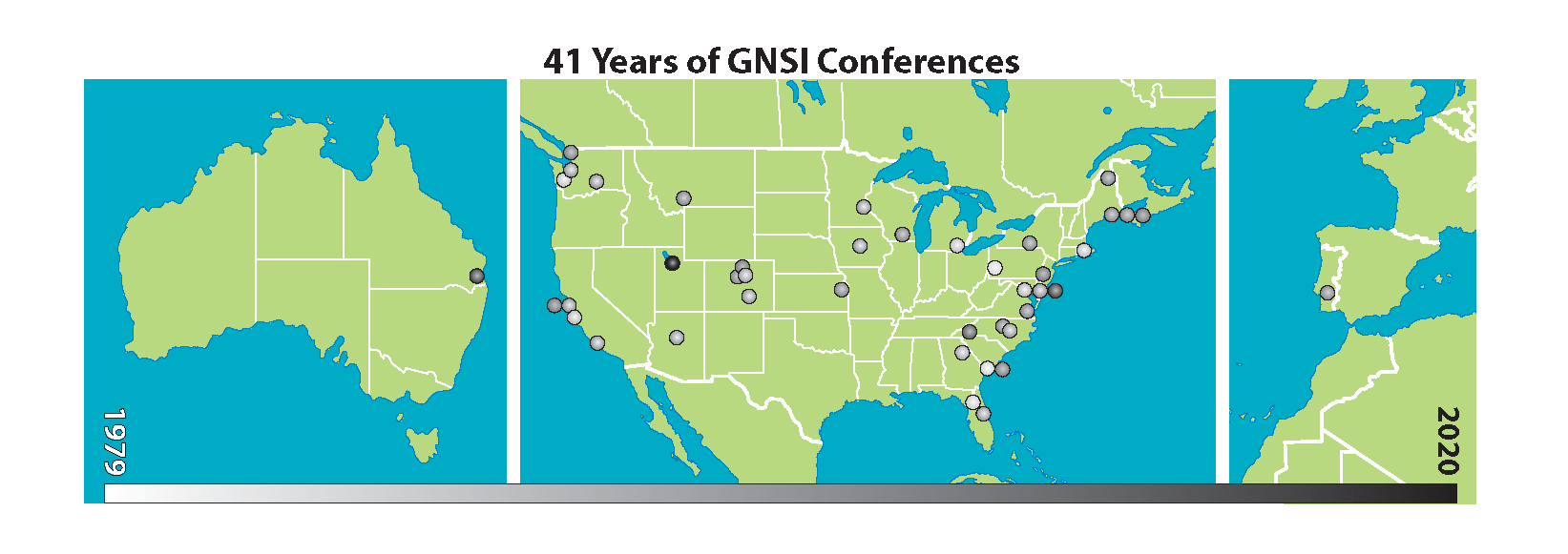
In the past, conference planners have made a conscious effort to select locations that represent geographic diversity not only to provide conference-goers with variety, but also to ensure that travel costs are more evenly distributed among attendees -- some years those who live on the West Coast must travel east and some years Easteners must travel west. In addition to the coasts, meetings have been held in the far north (Fort Kent, ME), the South (Savannah, GA) and the Midwest (Lawrence, KS). Look at the map to see where we have held meetings in the recent past! Despite an effort to provide conference-goers with this variety, the sites chosen are largely dependent on what is most convenient for the coordinator(s). There are a number of interesting locales where meetings have never been held. (How about western Kentucky or northern Texas?) If you live in or have access to a location that could provide our members with new experiences, let us know by contacting the GNSI -- and consider serving as a conference coordinator or an “on-site” conference consultant!
Have an idea for a conference location? Consider filling out our GNSI Visual SciComm Conference Scouting Form