
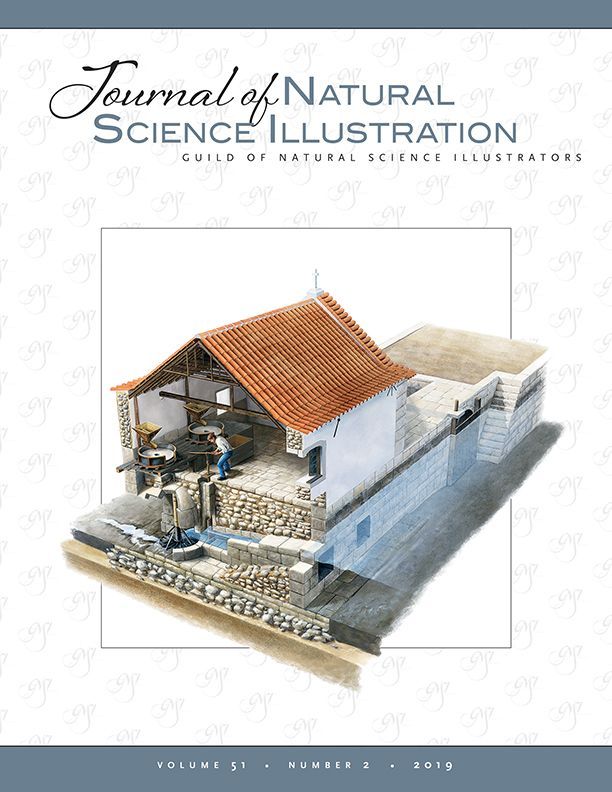
Welcome to the second Journal edition of 2019!
Greetings from your Journal team! We are pleased to bring you this summer issue of the Journal. We think you will find in it some exciting examples of visual communication of information about the natural world.
In this issue, Xavier Pita shares with us the use of customized digital watercolor brushes in illustrations for the Corroios salt marsh and tide mill project. Bruce Kerr details a rendering of invasive species in digital media. Sally Cox demonstrates pop-up cards, which can be used for studio promotions or exhibits. In addition, we have a member spotlight of Rick Simonson, whose company, Science Lab Studios Inc., offers science communication services. We are also pleased to bring you the student portfolio gallery for CSUMB, and a collection of sketches by David Nielsen.
Log into your account to view the Journal: JNSI 2019, Vol. 51, No. 2
Not yet a subscriber? To view the issue for free,
become a GNSI member today!
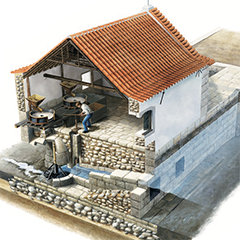
The Corroios Salt Marsh and Tide Mill
— Xavier Pita
“The Corroios salt marsh is one of the richest natural habitats in the Tagus River estuary area in Portugal, with its beauty contrasting the highly urbanized surroundings. The idea for this project came from the first time I visited the area in the Spring of 2012.” In this article, Xavier explains the techniques he used to create the artwork which comprises of five panels about the salt marsh, six panels about the tide mill, and one panel about the tides.
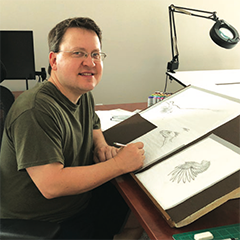
Member Spotlight: Rick Simonson (Open Access)
GNSI member Rick Simonson describes how his interest in science and art led him to a career in scientific illustration. “I was born in Minneapolis and grew up on a farm near Benson, Minnesota. Growing up on a farm certainly nurtured my interest in the natural world; I’ve always loved drawing and being outside.”
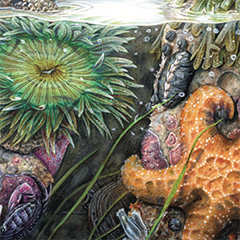
CSUMB Final Portfolio Exhibit
— Elena Hartley and Stephanie Kinkel
“The Pacific Grove Museum of Natural History buzzed with excitement on Friday, May 3, as attendees celebrated the annual opening of this year’s Illustrating Nature exhibit.” This article highlights works by students in the Science Illustration Certificate Program at California State University, Monterey Bay (CSUMB).
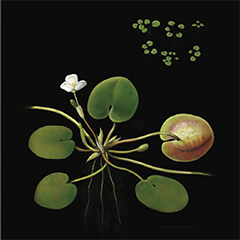
Michigan Invasive Aquatic Species
— Bruce Kerr
Traditional media techniques can be adapted for use in digital media to create a rich, varied texture that can be duplicated in print as well as electronic media. The techniques shown here, as applied to a recent commission, were originally developed while working as a commercial and scientific illustrator. This article will attempt to provide a bridge between the digital and traditional worlds for those interested in further exploring the digital medium.
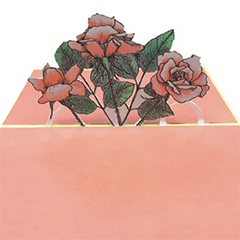
Pop-Up Gift Cards
— Sally Cox
“Pop-up cards are unique forms of paper arts that utilize elements of 3D paper architecture. They make excellent gifts for special occasions, and they could be impressive as promotional materials or proposals.” Read on as Sally use her own creations in a pop-up structure.
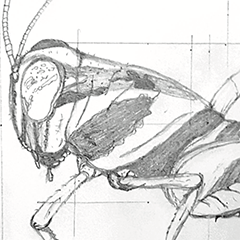
From the Sketchbook: David Nielsen
David Nielsen is an Entomologist with the Nebraska Department of Agriculture (funded by the USDA) and the US Army. He enjoys illustrating insects and mites he collects from his work to showcase the variety that exists in nature.