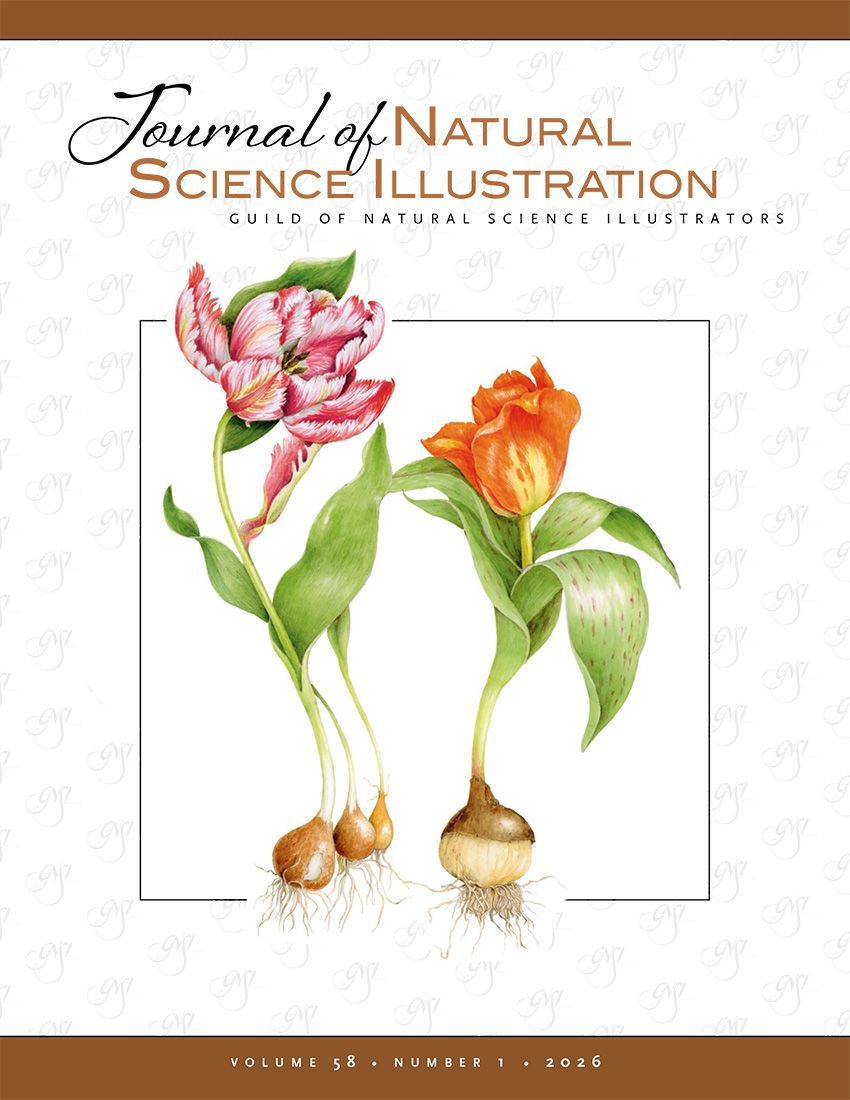

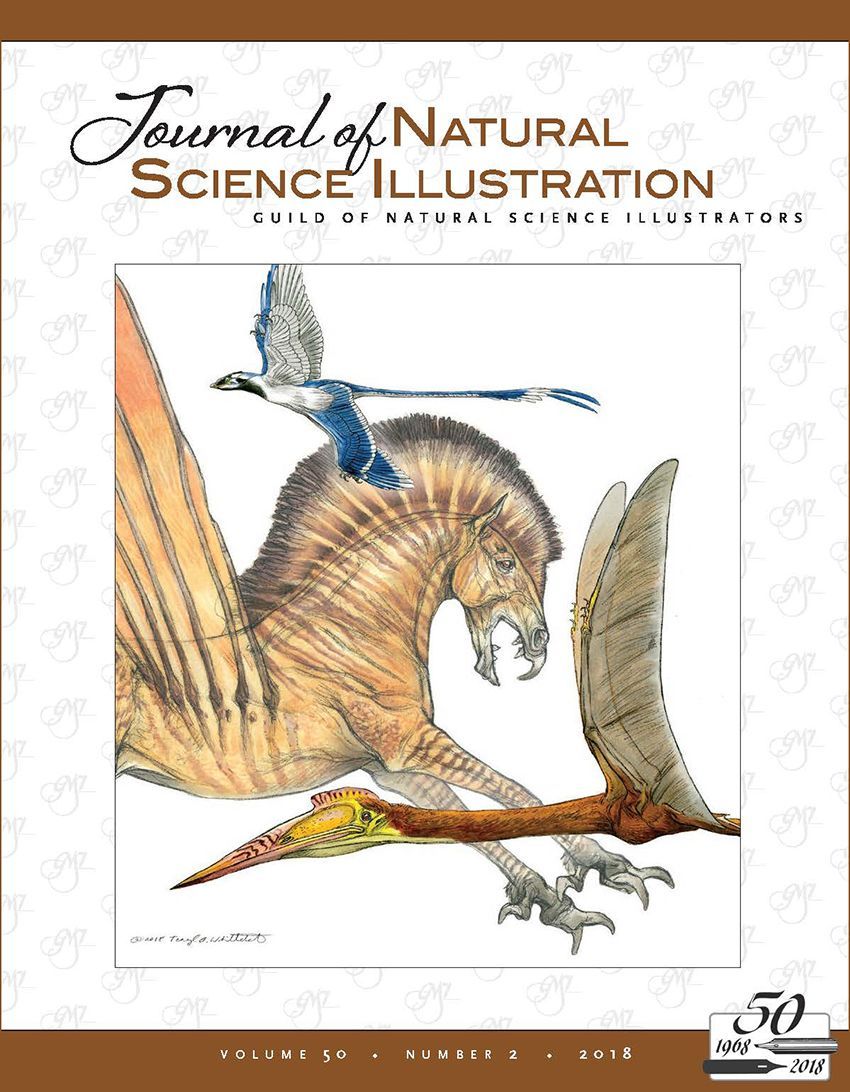
Welcome to the second Journal edition of 2018!
This issue truly demonstrates the great variety of disciplines, techniques, and interests of our GNSI family. Read all about our impressive array, from illustrating flying paleo vertebrates and 3D molecular landscapes, to a book review of stunning botanical illustrations from the UK, and a Member Spotlight on Mesa Schumacher’s fascinating and ever-evolving career. We round out the issue with art from the California State University -Monterey Bay Scientific Illustration program’s graduation exhibit and wrap up with a review of GNSI-Great Plains Chapter events.
Log into your account to view the Journal: JNSI 2023, Vol. 50, No. 2
Not yet a subscriber? To view the issue for free, become a GNSI member today!

Wings, Tails, and Real Flying Monsters: Illustrating Flying Vertebrates
— Dr. Michael Habib, with illustrations by Terryl Whitlatch
Understanding the mechanics of flying creatures is an important skill to have in one's tool kit when you approach the realistic recreation of paleo flyers. These same mechanics can be used to inform the creation of imaginary flying animals. The fossil record, as well as the practical mechanics observable in extant flying animals are most instructive for our recreations.

Creating a 3D Molecular Landscape
— Layla Lang
Layla demonstrates a few basic 3D modeling techniques, and explains how to add materials to 3D elements, export separate layers from Cinema 4D® to compose a complete illustration, and make color adjustments to achieve the envisioned mood in Adobe® Photoshop®.

Book Review: Rory McEwen:The Colors of Reality
— Frank Ippolito
“The artist's name is Rory McEwen; for many readers in the US, this may be the first time we will have heard his name. This fact is as startling as anything one will come to learn in this beautifully printed overview of Mr. McEwen’s life and work. Perhaps this is due, in part, to the fact that Mr. McEwen’s botanical illustration career flourished in the UK over 30 years ago. Thumb through the volume and prepare to be engaged by the range of subject and impressed by the treatment that appears under one’s fingers.”

Member Spotlight: Mesa Schumacher (Open Access)
Join Mesa on her career path journey in this fascinating article.
“Like many in this field, I am often asked if I see myself more as an artist or a scientist, and I believe I fall pretty close to the middle of the spectrum (if a “spectrum” exists). Science is what we observe, or what we can deduce. Art is the way I process what I see, what I know, and how I understand the world.”

ILLUSTRATING NATURE: Presenting the 2018 graduating class of the California State University Monterey Bay (CSUMB) Science Illustration Program
— Jann Griffiths
Enjoy this presentation of works from the exhibit by the 2018 graduating class of CSUMB.

Chapter Happenings: A Look At GNSI Chapter Activity, Part II
Read all about recent activities by the Great Lakes and Great Plains chapters.