Paleoart (and the paleoartist) in the Service of Scientific Research
by Simone Zoccante
Unless otherwise noted, all images © Simone Zoccante

Figure 1: AMNH concept image of the accordion walls in the Family Learning Zone.
When observing a piece of paleoart, such as a reconstruction of an extinct organism or ecosystem, it’s easy to be captivated by the visual impact of the image. Scenes of a Deinotherium feeding in a Miocene forest, an Allosaurus hiding in vegetation ready to launch its attack, or a woolly rhinoceros wandering through a desolate steppe may seem like the products of an artist’s imagination but, behind each of these images lies a complex process and a demanding craft, where scientific research, in-depth study of a wide variety of sources, comparative anatomy, and artistic interpretation coexist in a delicate balance.
Through my three-year journey with this project, I added large-scale watercolor painting techniques to my repertoire, learned the process of working with a large institution, and tested my resilience as an artist.
In November 2021, I received a mysterious email from a designer at Argyle Design Group, an exhibit design firm based in New York City. They found my portfolio on Science Meets Art, a website for science illustrators to post their portfolios online. They were gauging my interest in providing mural illustrations for the newly renovated classrooms at the Family Learning Zone (FLZ)
at the American Museum of Natural History (AMNH). These murals would be used for their youth education programs to teach young students about different environments and biodiversity. Each mural was to highlight one of four specific environments—Panamanian Rainforest, Jamaica Bay Estuary, Northeast Deciduous Forest, and Big Bend Texas. The murals would consist of magnetic-backed, printed graphics with a protective laminate, plus movable magnetic-backed images of plants and animals that could be found in each environment.
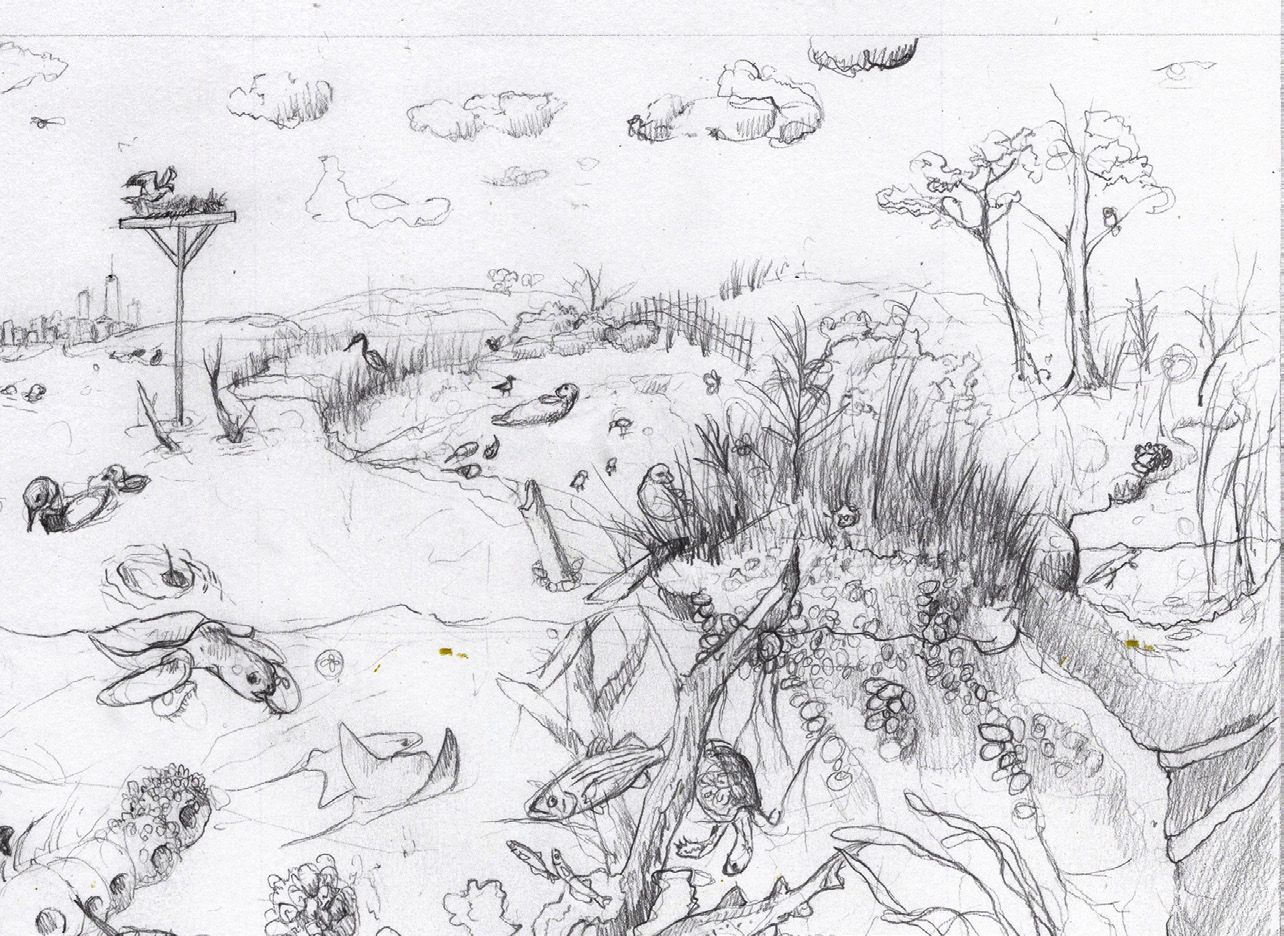
Figure 2:
(left) Detail from the initial concept sketch for the Jamaica Bay Estuary.
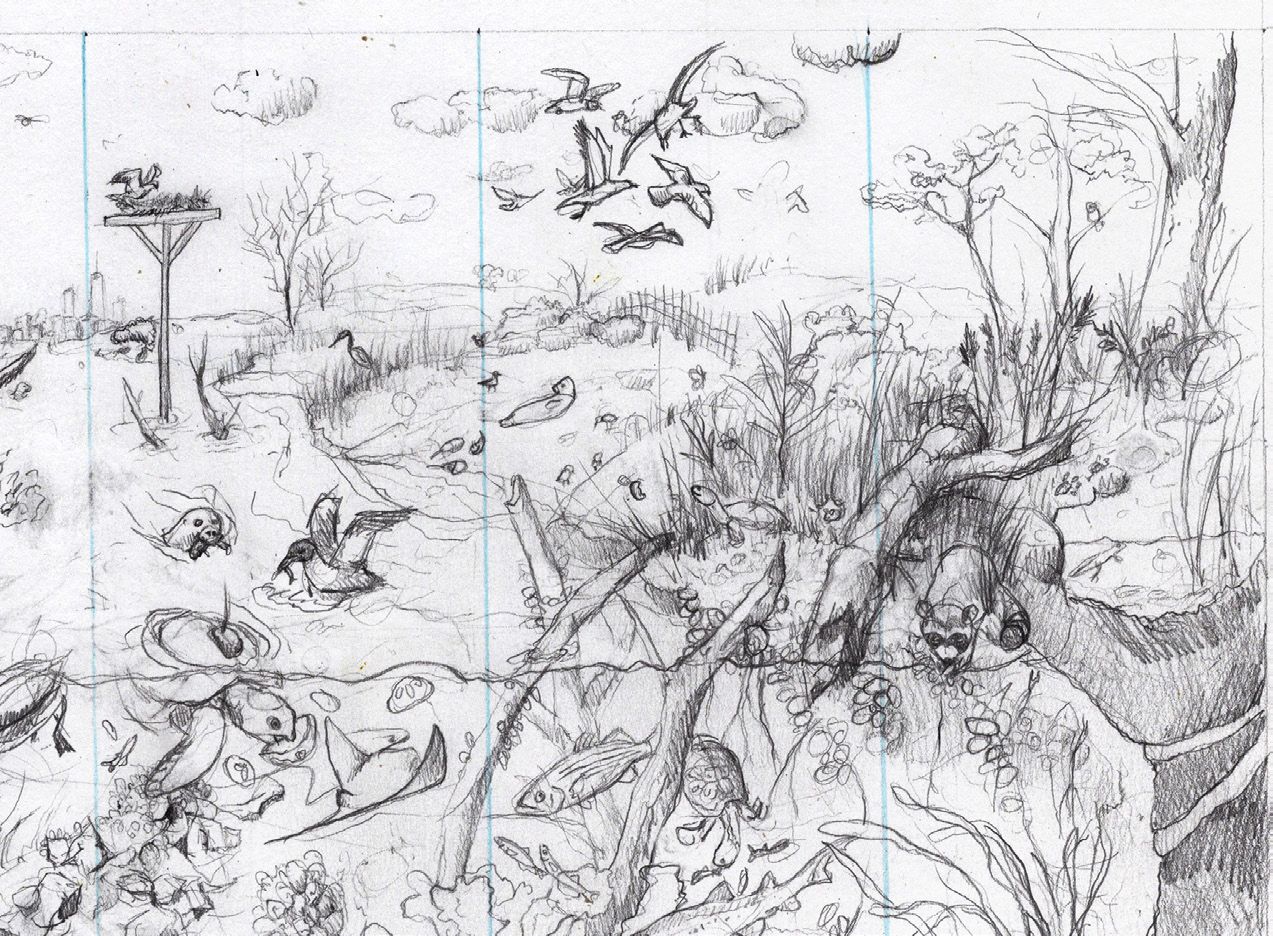
(right) Matching detail from the final sketch, drawn to scale and incorporating feedback from the AMNH team.
Mural Construction
There are four classrooms in the Family Learning Zone. Two of the murals were to be mounted on either side of a movable accordion wall dividing two classrooms. The other two murals are mounted on the interior walls and molded around the architecture of the classroom (Fig. 1).
I was equally excited and nervous to jump into such an extensive illustration project. All four environmental murals began with multiple conversations with the AMNH team about what aspects they wanted to feature in each environment, which biomes to represent, the plant and animal species to highlight, and how students would interact with the pieces. The AMNH team provided a spreadsheet of plants, animals, fungi, and geological features that each mural should incorporate. They provided some reference photos for the corresponding environments. I also used various photo references from iNaturalist, screenshots from BBC nature documentaries, and field guides.
Additionally, I visited different environments that could be analogs to the environments depicted in the murals—such as state parks in Virginia for the Northeast Forest, tropical conservatories for the Panamanian Rainforest, and the Eastern Shore of Maryland for Jamaica Bay Estuary.
In February 2024, I had the opportunity to visit Big Bend National Park with my dad prior to working on the Big Bend Texas mural. While I was in the park, I spent time plein-air watercolor painting, sketching botanical textures, and taking photo references of the natural light in the park. The experience in the National Park, as well as my experiences in the other environments, helped me capture lighting, botanical growth, and animal interactions in order to create richly detailed illustrations.
For each murals’ illustration, I created three preliminary sketches for review: multiple rough concept sketches based on the team’s broad ideas; a refined sketch of the chosen composition; and lastly, a tightly rendered final sketch (Fig. 2). At each stage, the AMNH team had opportunities to provide feedback on composition, the illustration’s narrative, and any mistakes. I drew the final sketch to scale, showing architectural features, plants, and animals in their final positions. Before I transferred the sketch to watercolor paper, the AMNH team reviewed and approved the final sketch. After my sketches were approved, I carefully transferred the final sketches to mounted watercolor paper using a grid to accurately draw and enlarge the compositions.
Each mural illustration presented its own unique challenges whether in size, environmental lighting in the installation area, or painting time constraints.
My first challenge was figuring out how to translate my normally small-scale illustrations and expand them into wall-sized illustrations. The finished mural illustrations were created at a ¼ scale to the wall. The movable magnetic-backed spot images were created at a full size (Fig. 3).
I first experimented by painting on four separate sheets of 22” x 34” 140lb ARCHES® Cold Pressed watercolor paper for the Panamanian Rainforest mural. This trial was only moderately successful—it took a lot of time to physically and digitally align the initial drawings, and working on separate panels proved to be challenging with matching colors and drawing alignment.
For the remaining three murals, I switched up my process and mounted 140lb ARCHES® Cold Pressed paper cut from a roll onto wooden heavy-duty canvas stretcher bars, similar to a stretched canvas. This process proved much more successful since I had a continuous 48” x 36” work surface for each mural and minimal paper warping
(Fig. 4).
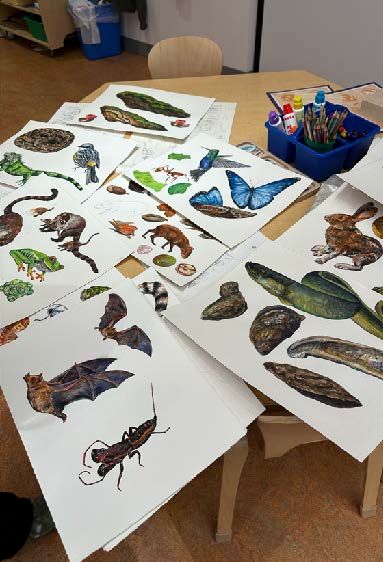
Figure 3:
The entire spread of my original watercolor illustrations used to create the magnetic elements for the murals rendered at full size.
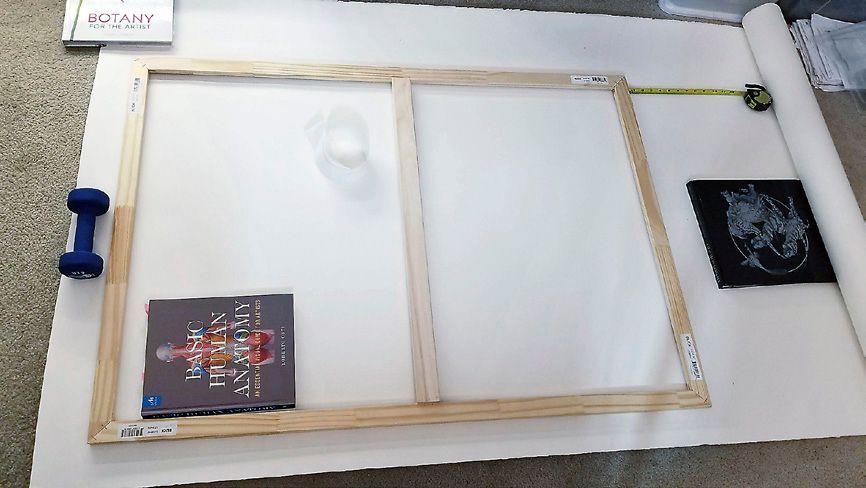
Figure 4: 48 x 36 inch watercolor canvas setup: ARCHES® 140lb Cold Pressed watercolor paper measured and laid out, 3 inch overlapping the stretcher bars, sprayed paper with water, carefully fold and staple paper onto the bars, and allow paper to fully dry and become taut.
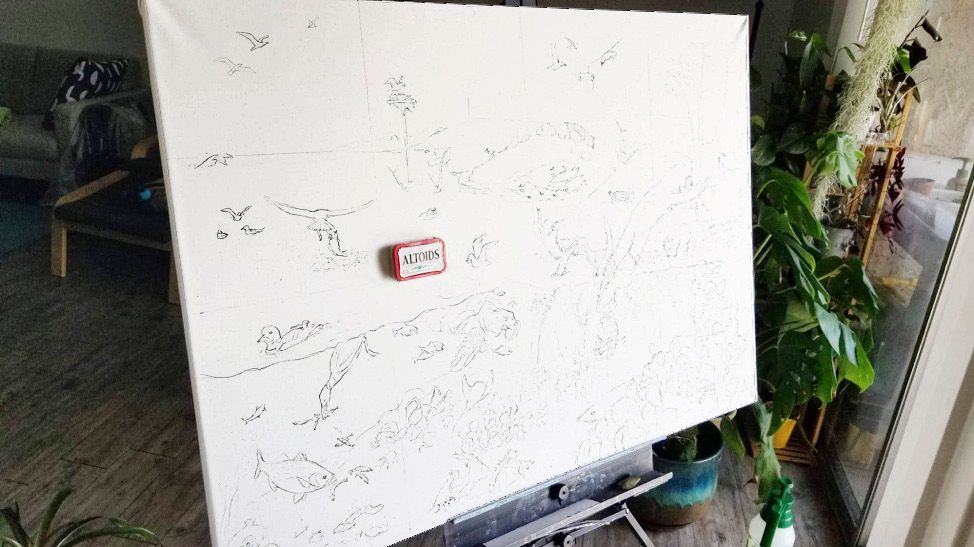
(right) Sketch process: I gridded the sketch and the stretched watercolor paper, transferred the drawing to the stretched paper, and refined my drawing to match the final sketch. (Altoids tin for scale)
Each mural illustration was painted in transparent watercolor using primarily Windsor & Newton and Daniel Smith watercolors. I used a small amount of Holbein designer gouache to emphasize highlights and details (Fig. 5). While I worked on the large-scale watercolor paintings, I used large mop brushes to create more expressive brush strokes in background washes.
In addition to the four main murals, each environment hosted 10–12 spot illustrations of plants and animals, which would be used as interactive magnets for students to place around the environments.
After completing each mural painting, I photographed each piece and scanned them in sections, then carefully wrapped them for shipment (Fig. 6). The illustrations were shipped to Laumont Printing in New York City for professional scanning at 300 dpi for production. Laumont Printing and the AMNH team handled all of the production and installation process.
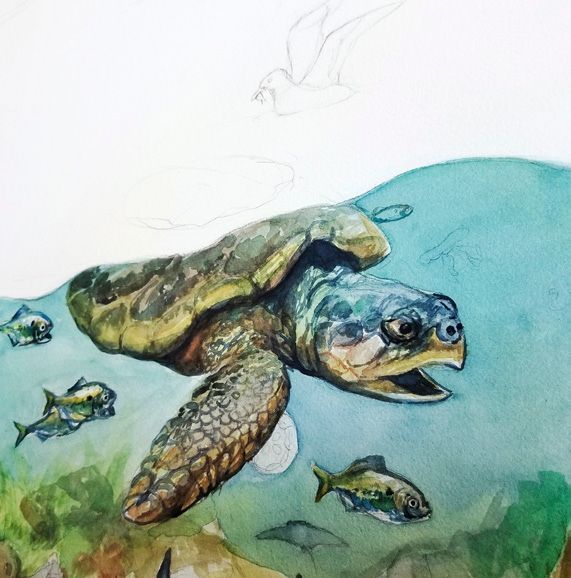
Detail of loggerhead turtle, menhaden fish, and (eventually) moon jellies.
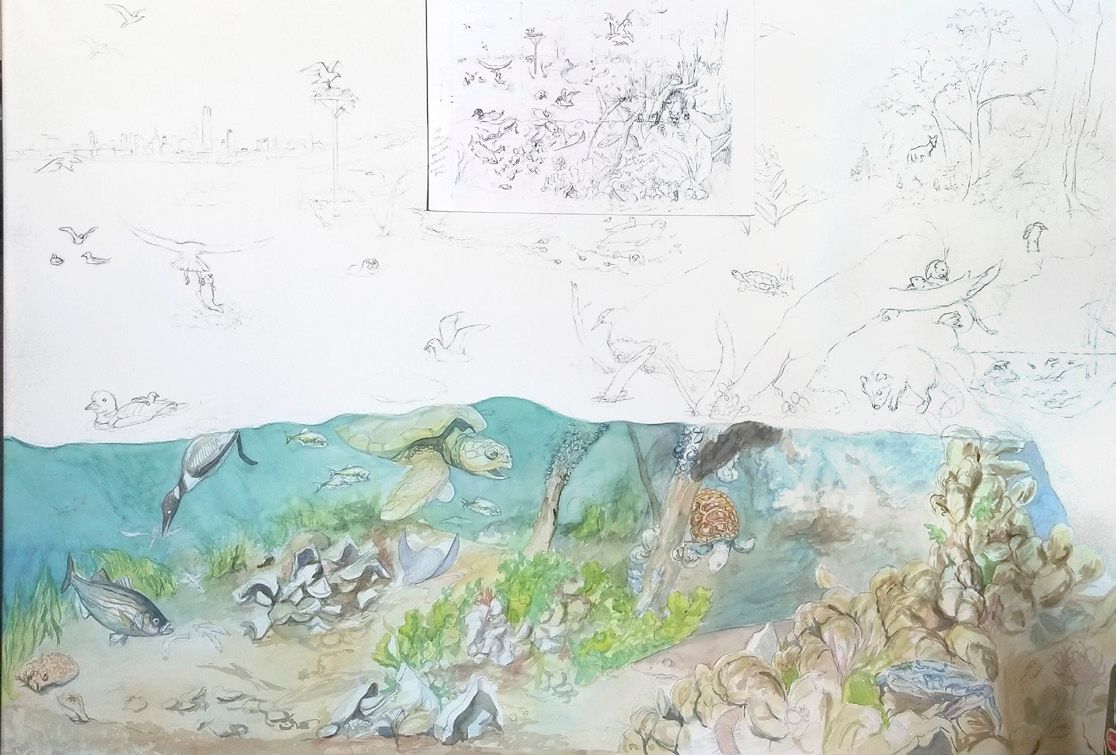
Figure 5: (left) I started painting in small sections with the sketch for reference and photo references on my iPad.
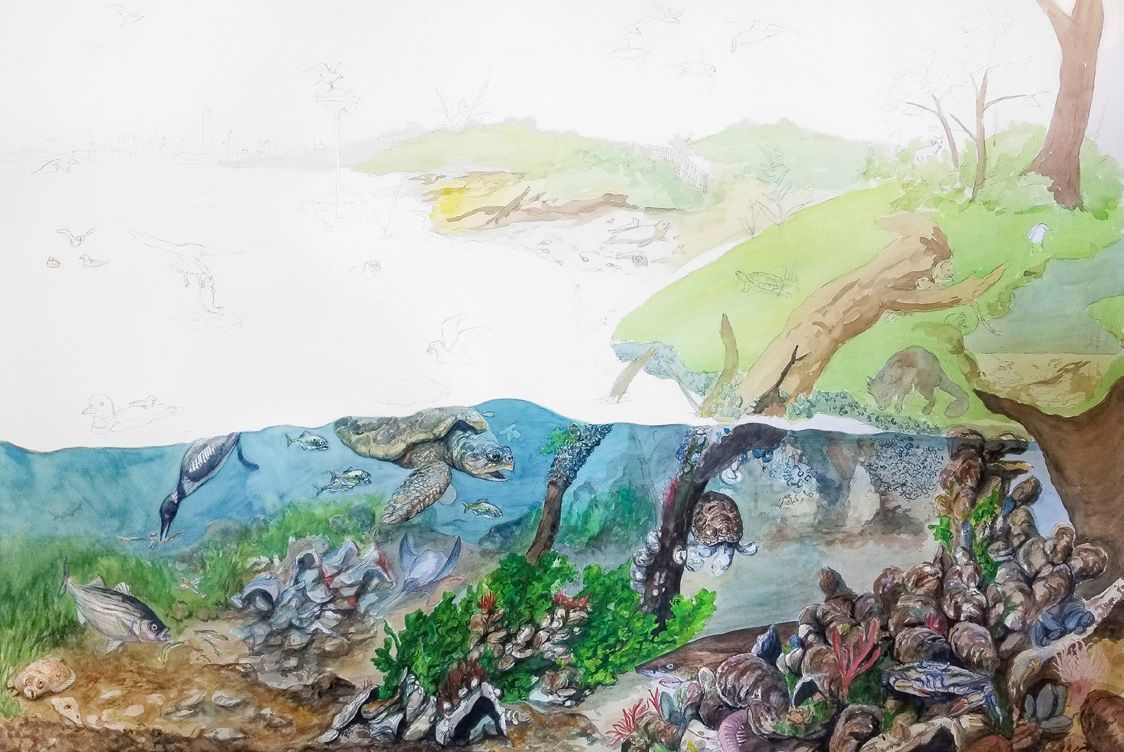
(right) Painting slowly progressing! I decided to paint this illustration in sections to mentally “speed up” my process.
The murals are now integrated into the Family Learning Zone’s curriculum for elementary and middle school students. Instructors use the murals in lessons about local New York ecology (Jamaica Bay Estuary and Northeast Forest ) and how other environments connect to New York (Panamanian Rainforest and Big Bend). The spot illustration magnets are used as interactive elements in the environments, where students can test out the camouflage of animals against different backgrounds, explore underneath leaves, and visualize animal migration across multiple environments.
In total, this project encompassed four watercolor paintings—one 36” x 36”, two 32” x 48”, and one 36” x 48”; 45 magnet spot illustrations of plants and animals, and about 3 years of sketches, multiple virtual meetings, and painting late into the night.
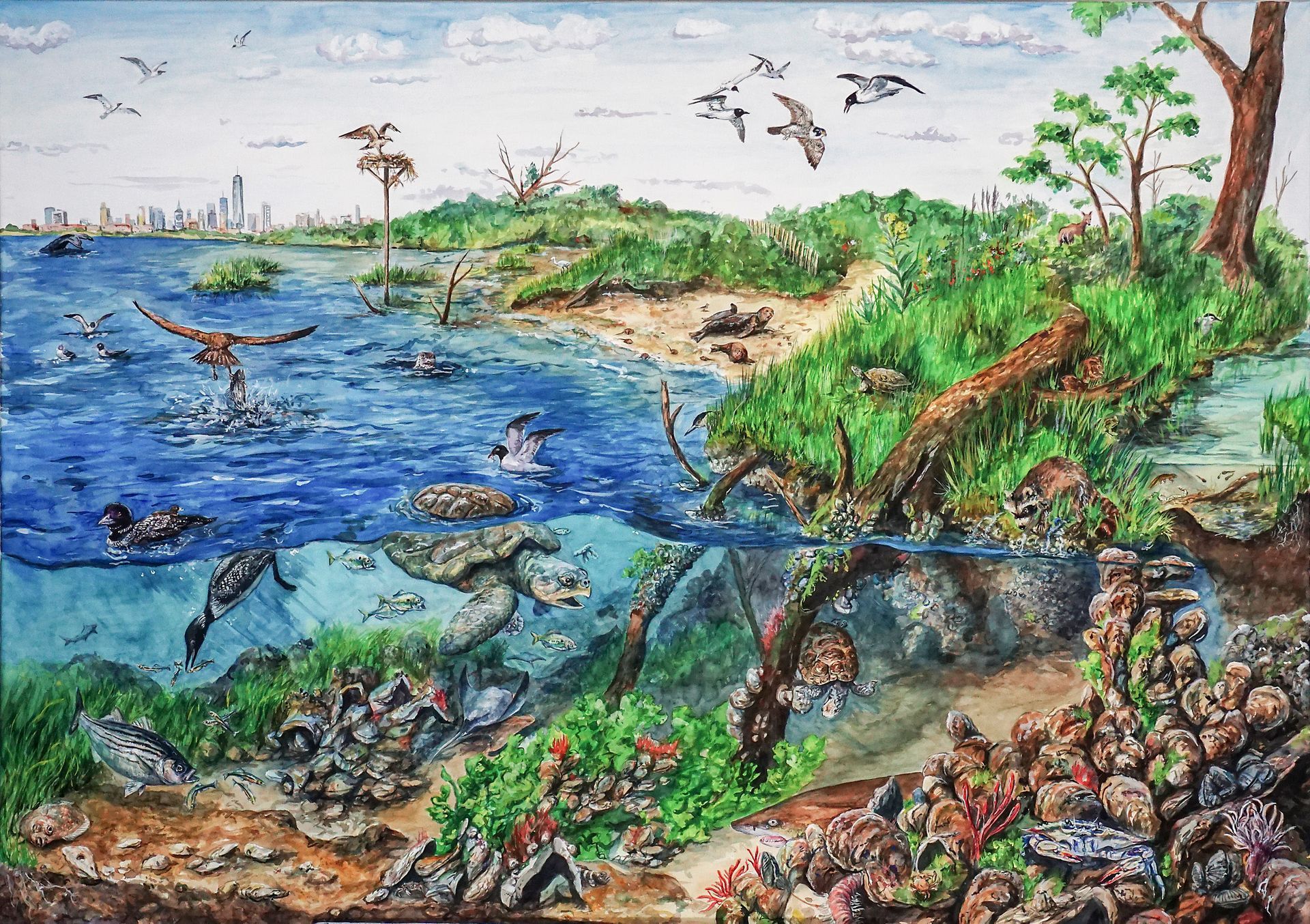
Figure 6: (above left) Scanned and edited Jamaica Bay Estuary mural, ready for installation.
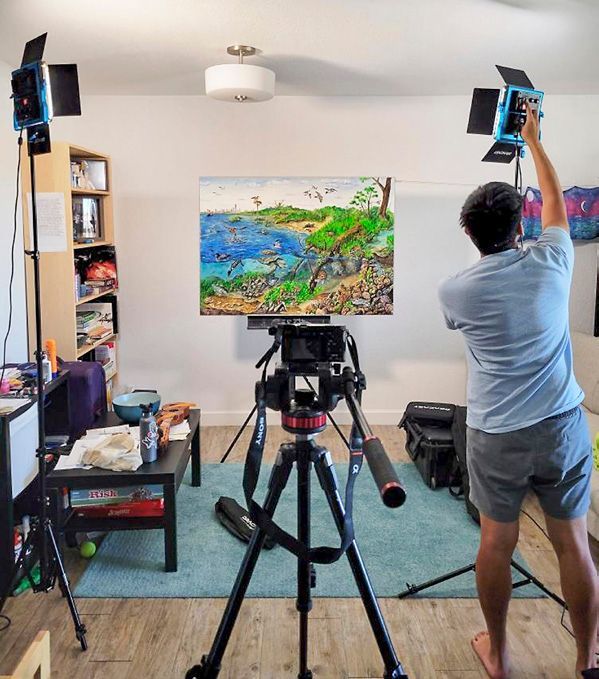
(above right) Initial documentation before shipping the painting to NYC for scanning. I capture photographs of the murals as back-ups in case something happened to the pieces while in transit.
In July 2025, I finally made it out to AMNH with my parents to see the installed murals (Fig. 7). I enjoyed seeing my work fully installed in the classrooms, surrounded by student artwork, live animal enclosures, and classes in full swing. I am also thankful for my friends and family supporting me along the journey.
I am incredibly proud of the countless hours of work that brought these pieces from simple pencil sketches all the way to the walls of the American Museum of Natural History.
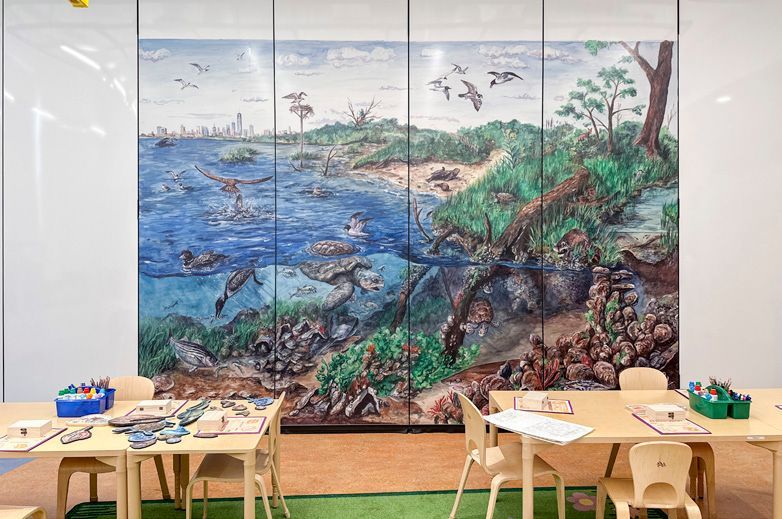
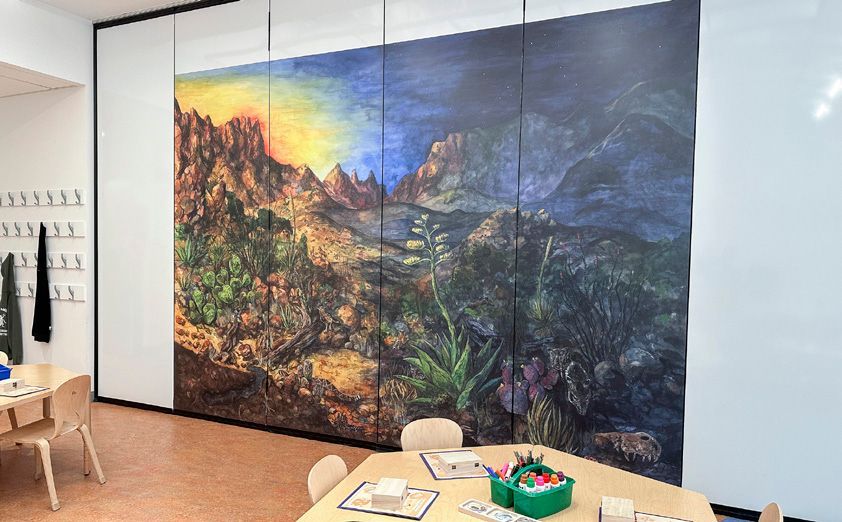
Figure 7: (top left) - Jamaica Bay Estuary Mural.
(bottom left) - Big Bend Texas Mural
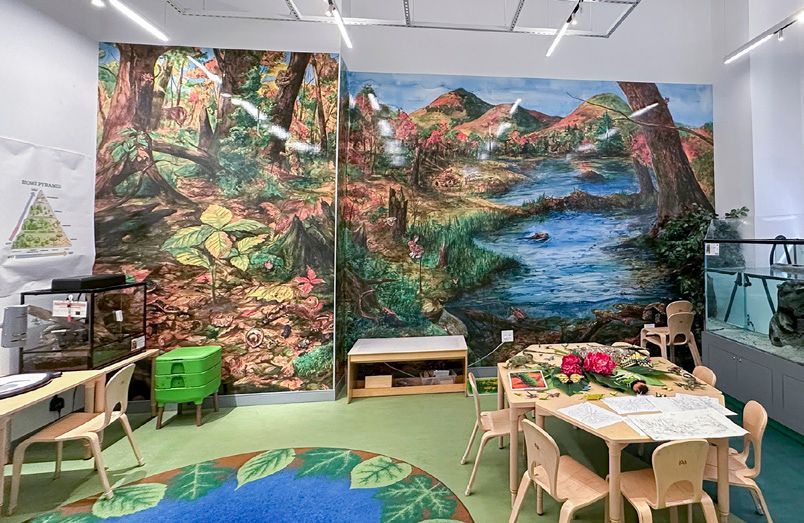
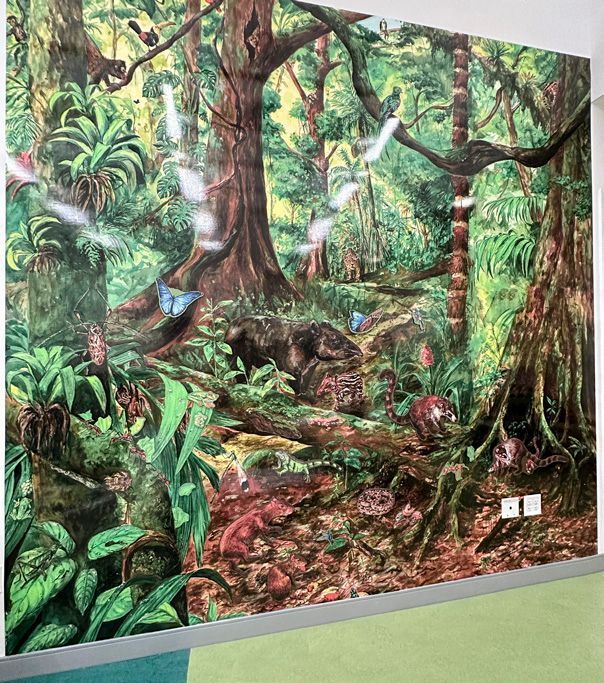
Figure 7 Continued : (top right) - Northeast Forest Mural
(bottom right - Panamanian Rainforest Mural
ABOUT TRENTON JUNG
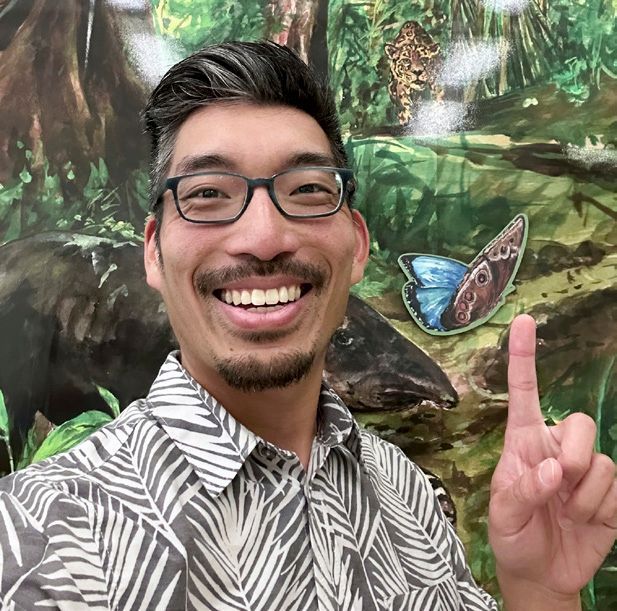
Trenton Jung is a natural science illustrator based in Seattle, WA. Born and raised outside of Los Angeles, CA, the sun and water play an influential role in his art practice. Trenton's work reflects his deep interest in organic forms, and focuses on the unseen and unnoticed aspects of nature. He uses a variety of mediums to represent his observations including watercolor, graphite, colored pencil, and gouache.
His work has been featured at the American Museum of Natural History, Smithsonian magazine, at the Woodard Lab (University of Riverside, CA), and in the science research journals Anthropocene and Nature.
This member-only article appears in the Journal of Natural Science Illustrators, Volume 58, no. 1 / 2026