Indigenizing Science Communication Through Art
Mallery Quetawki
Author • January 09, 2026
Zuni artist Mallery Quetawki translates environmental health research into culturally relevant Indigenous art. She uses traditional symbols to explain complex scientific issues for Native communities, bridging Western science and Indigenous knowledge while building trust in research partnerships.
INTRODUCTION
Zuni Pueblo—or Shiwinna, as we call it—is one of the nineteen Pueblos of New Mexico. We are the furthest west, with land in both New Mexico and Arizona. I was raised traditionally while engaging with the modern Western world yet remaining rooted in my cultural heritage. That heritage is why I create art.
In Zuni culture, we share everything across generations through storytelling, song, dance, and art. Every symbol, color, and shape has meaning. All colors represent directions. We recognize six different directions: north, south, east, west, up, and down. Each direction has its own meaning and animal symbol.
AN ACCIDENTAL DISCOVERY
My journey into science communication through art happened by accident in 2007, during undergraduate biology studies. Wanting to become a physician, I was balancing heavy science courses with art classes. For an advanced art portfolio, I needed to develop as an artist. Since I also needed to study anatomy, I thought, "Let me combine the two courses by drawing the human body."
I created a series of pastels overlaid with India ink and white acrylic. This wasn't just about academics—I had an issue to address. When I left my village for undergraduate research in Oakland, naysayers said, "She's been assimilated. She'll forget who she is, her language, come back city-like and disconnected from our lifeways."
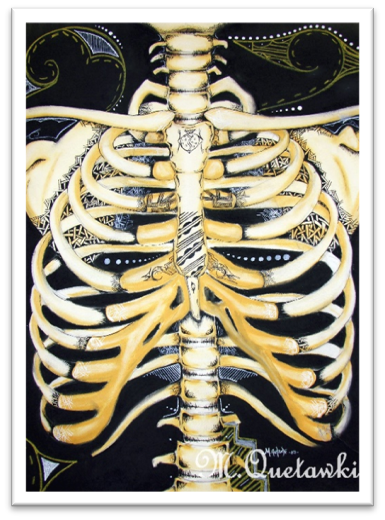
Figure 1: Skeletal System. 2007. Pastel and ink. 22x28 in.
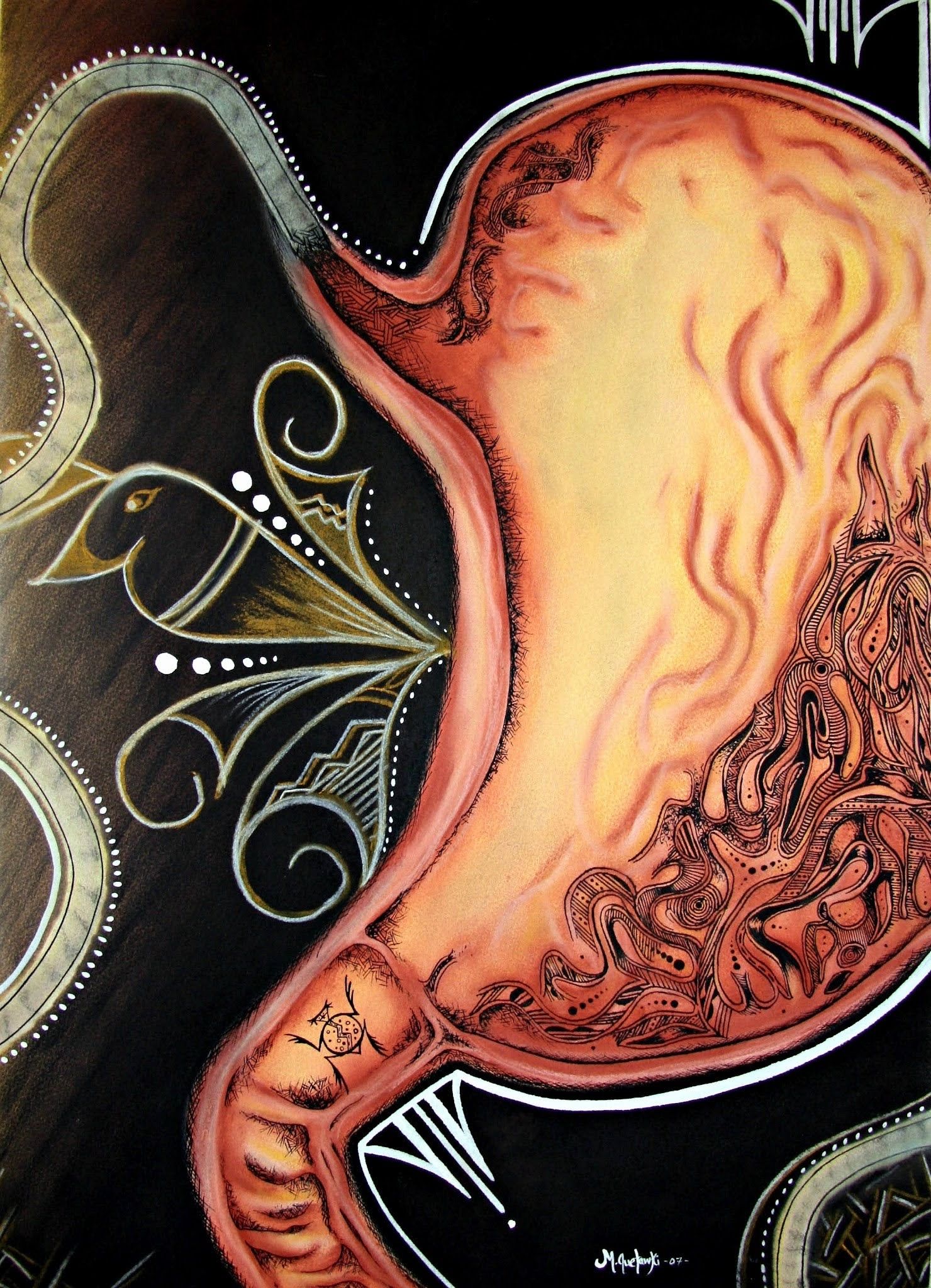
Figure 2:
Stomach. 2007. Pastel and ink. 22x28 inches.
I took great offense and channeled my response into art. I called the series "What Makes a Zuni" to show that when you open me up, look into my veins, bones, and arteries, I'll always be Zuni (Fig. 1). You cannot undo what has been created. Everything is etched inside us down to the spirit and flesh.
UNEXPECTED COMMUNITY IMPACT
Our community in New Mexico relies on one clinic—the Zuni IHS hospital—for 13,000 people. It's underfunded and underutilized because our community has a distrust and fear of doctors. My art (Fig. 2) was present in the clinic, and a physician once told me: "People are asking me, 'Is that what my stomach really looks like? That looks cool. Is that healthy? How do I keep it that way?'"
I wanted to become a physician because I didn't understand why community members waited so long to seek care. Diabetes meant losing limbs, going on dialysis in their twenties. We had high rates of kidney disease and diabetes, but why couldn't we catch these early? Historically poor interactions with western medicine and language is part of the answer.
We needed better health education and proactive healthcare, encouraging people to get involved in their health journeys. But they struggled with dialogue due to language barriers— Zuni is a language isolate spoken only by us—and cultural barriers, since we're one of the most traditional Pueblo communities.
THE ENVIRONMENTAL HEALTH CONNECTION
Years later, the Community Environmental Health Program director visited the clinic after meeting with the Navajo Nation about abandoned uranium mines and heavy metal exposures. The community had said, "We appreciate your science, but we have no idea what you're saying. We're visual learners. Maybe share art.” When the director saw my anatomical series, we began working together.
CREATING ART WITH PURPOSE
Now, I create art to help communities understand environmental health and science. My most popular pieces help communities understand DNA and what occurs from mixed metal exposure—DNA damage, repair, and structure (Fig. 3).
Every time I hear researchers share science findings, I ask: "How would I tell my ninety-year-old grandmother this? How would I explain uranium hazards to someone with an eighth-grade education?" Or: "How would I tell my middle-school children about uranium and radiation?"
I dig deep into my roots and the communities we work with, considering their worldview. How do they see their environment? How are they related to it and each other? Native communities are not a monolith—each is different from even their closest tribal neighbor. Among New Mexico's nineteen Pueblos, each one is unique. Information must be tailored for each specific community.
Three Goals in My Work:
- Translate scientific information while collaborating with researchers.
- Bridge bidirectional communication. This means talking with, not at, communities while involving government entities and policymakers.
- Create inclusive environments and rebuild trust with and across institutions.
CULTURAL SENSITIVITY
Our science operates at the cellular level but we must include healing aspects. In many Indigenous communities of the Southwest, it is considered inappropriate to begin conversations with bad news—death, dying, war, chronic illness. We can't just say, "You could have cancer. You're radiated." Instead, we can tell our communities that our bodies naturally repair DNA (Fig. 4).
I talk about DNA as beads on a string, like a necklace. We wear many necklaces; each is beautiful and unique. When necklaces break, we don't discard them—we repair them.
My palette is turquoise-heavy. Turquoise is a protective stone for Southwest tribes. We wear it constantly and include it in ceremony, making it central to my art and communication.
This is paragraph text. Click it or hit the Manage Text button to change the font, color, size, format, and more. To set up site-wide paragraph and title styles, go to Site Theme.
This member-only article appears in the Journal of Natural Science Illustrators, Volume 58, no. 1 / 2026