
Natural History of Edward Lear, New Edition, by Robert McCracken Peck foreword by David Attenborough
Edward Lear (1812–1888) is best known for his witty limericks and nonsense verse. But the celebrated author of The Owl and the Pussy-Cat also created some of the most stunning paintings of birds and mammals during an age when many species were just being discovered and brought to private menageries and zoos throughout Europe.

Sir David Attenborough and Robert McCracken Peck re-examining Edward Lear watercolors at the Houghton Library, Cambridge, Massachusetts.
Edward Lear (1812–1888) is best known for his witty limericks and nonsense verse. But the celebrated author of The Owl and the Pussy-Cat also created some of the most stunning paintings of birds and mammals during an age when many species were just being discovered and brought to private menageries and zoos throughout Europe. In the Natural History of Edward Lear, New Edition, author Robert McCracken Peck, an authority on ornithological illustration in the United States, sheds light on Lear’s creativity, productivity, attention to natural science detail, and success as an artist. Through Peck’s extensive 20-year research in the Houghton Library at Harvard University, this book contains more than 200 of Lear’s beautiful and detailed illustrations of animals, plants, and landscapes.
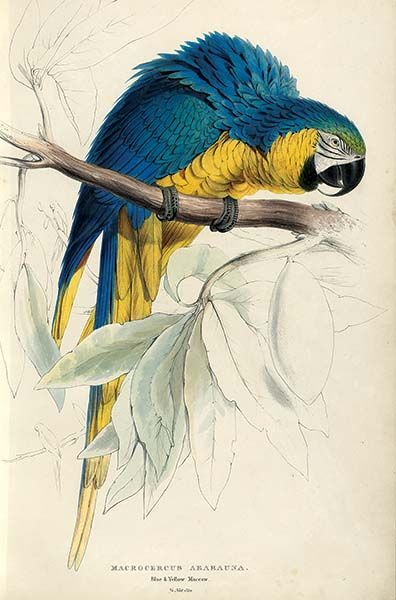

Left: Blue and yellow macaw, Macrocercus ararauna, now known as Ara ararauna, dated December 1831. Hand-colored lithograph, plate 8 from Edward Lear’s Illustrations of the Family of Psittacidae, or Parrots (1830–1832). Featured on the cover of the new paperback edition.
Study for Lear’s plate of the red and yellow macaw (Macrocercus aracanga), now known as the scarlet macaw (Ara Macao). Watercolor over graphite.
The author writes of Lear’s humor, extensive travels, and his important place in the history of science. He explains how Lear influenced other 19th and 20th-century artists such as Beatrix Potter, Maurice Sendak, James Prosek, and Walton Ford. Robert M. Peck presents an overview of Edward Lear’s wide range of artistic talents including detailed illustrations, thumbnail sketches, color studies, painting, lithography, multimedia in single compositions, and poetry.

Red and yellow macaw. Handcolored lithograph from Lear's Illustrations of the Family of Psittacidae, or Parrots (1830-1832).

This cartoon was an example of Lear's “zoomorphism or anthromorphism—making many of his human characters look more like birds and animals.” Perhaps Lear waltzing with a bluebottle fly. From More Nonsense, Pictures, Rhymes, Botany, Etc.,1872.
Early Years and Continuing Artistic and Literary Experiences
During a challenging early childhood, Edward Lear, through his intense curiosity of the natural world, created detailed illustrations with guidance and encouragement from his two older sisters, Ann and Sarah. From these early experiences, Lear developed his artistic skills, ingenuity, and work ethic capturing the essence of life in all of his natural subjects.

Eagle owl, lithograph, Academy of Natural Sciences of Philadelphia, Drexel University (QL690A1G6).
As Lear continued his artistic pursuits, he visited the London Zoo as well as the Royal Menagerie at the Tower of London, where he sketched animals and birds from life. Edward T. Bennett, one of the founders and long-time officer of London’s Zoological Society, was among the first to enlist Lear’s help in depicting the zoo’s residents. Bennett, a surgeon with a London hospital and with a private practice, may have been one of the practitioners for whom Lear produced some medical illustrations.
At age 18, after studying lithography, Lear produced an extensive scientific monograph with watercolor overlays titled The Illustrations of the Family of Psittacidae, or Parrots (1830–1832). This was the first English natural history book to focus on a single family of birds. Through this publication, Lear established his reputation as the artist of choice for many of the leading ornithological publishers in Britain in the 1830s and 1840s.
During his preparatory drawing and painting of this monograph, Lear painted color swatches around the birds—testing and developing accurate color recipes for the correct colors of the birds. He also produced smaller thumbnail sketches around the edges—further studies from the birds’ movements during his on-site drawing sessions. After successful artistic experiences in England, Edward moved to Italy, and traveled to Albania, India, Australia, and the Far East.

Red macauco, lithograph, Academy of Natural Sciences of Philadelphia, Drexel University, (QL73D4D3).
Throughout Peck’s inspiring, detailed, and entertaining presentation of Edward Lear’s multi-talented life's journey, the reader will be introduced to a remarkable natural science illustrator and imaginative poet with a knack for limericks, rhymes, and nonsense verse for which he achieved great literary recognition. Many of Lear’s limericks and poems, written in the mid-to-late 1800s, were illustrated depicting some of the animals with human traits.
This book is recommended for study of science, art history and techniques, along with a dose of inspiration and humor. Peck provides extensive and informative notes, an appendix, acknowledgments, list of illustrations, selective bibliography, and index. In the conclusion, Peck writes, “Although they never met, the widely read British art historian and essayist John Ruskin (1819–1900) ranked Lear first among his favorite authors.”


Left: Heraldic Blazons of Foss, author’s collection.
Right: Detailed portrait of a cat. Watercolor over graphite.